Internationaler Ideenwettbewerb Rosenstein Stuttgart
Ausgangslage
Das Projektgebiet liegt unmittelbar am Stuttgarter Hauptbahnhof – ein Ort mit enormem städtebaulichen Potenzial und hoher Frequentierung durch Reisende, Anwohner und Besucher. Gesucht wurde ein Konzept, das eine konsumfreie, offene und generationenübergreifende Nutzung ermöglicht und zur sozialen Belebung des neuen Bahnhofsviertels beiträgt.
Konzept
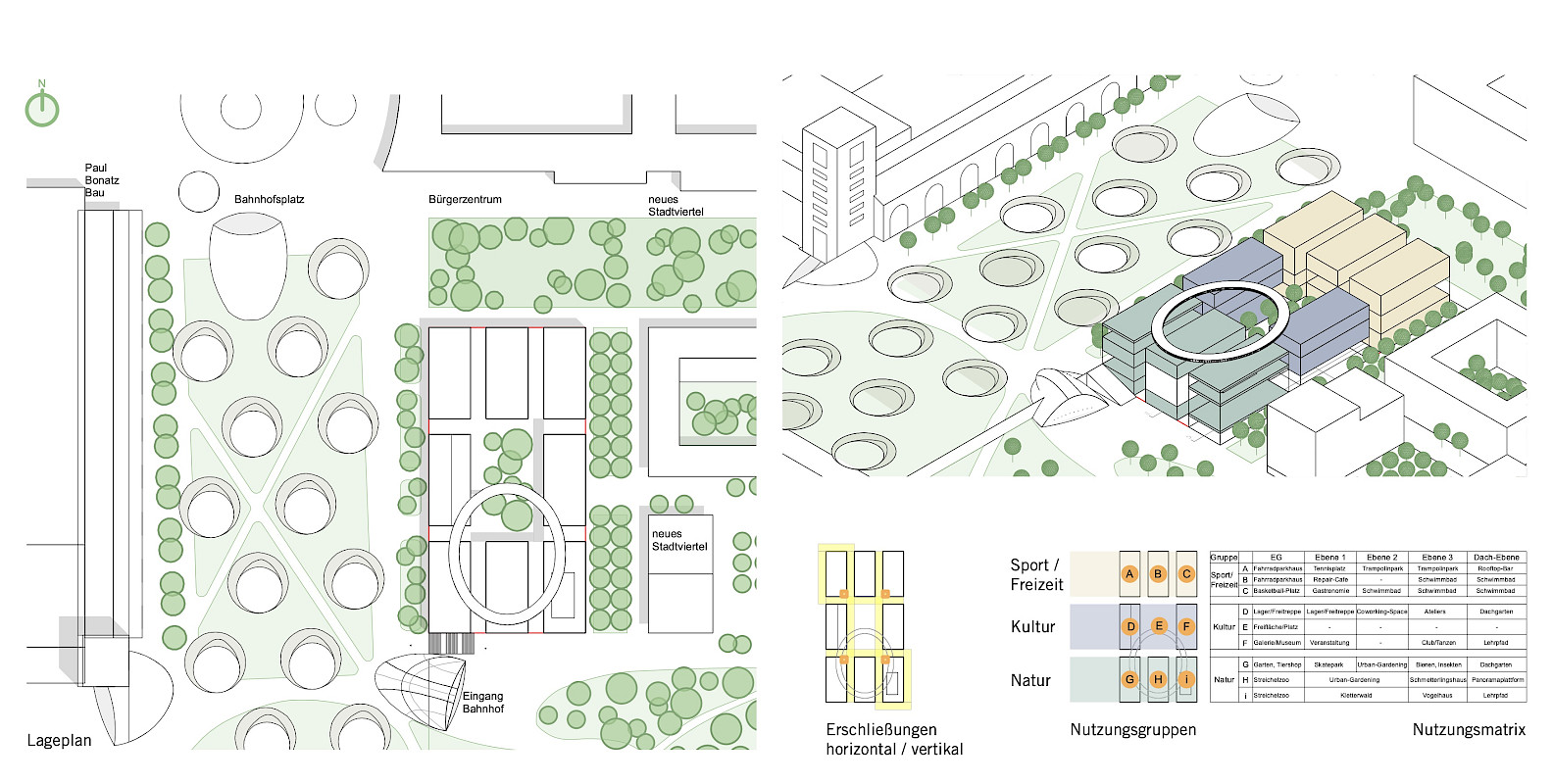
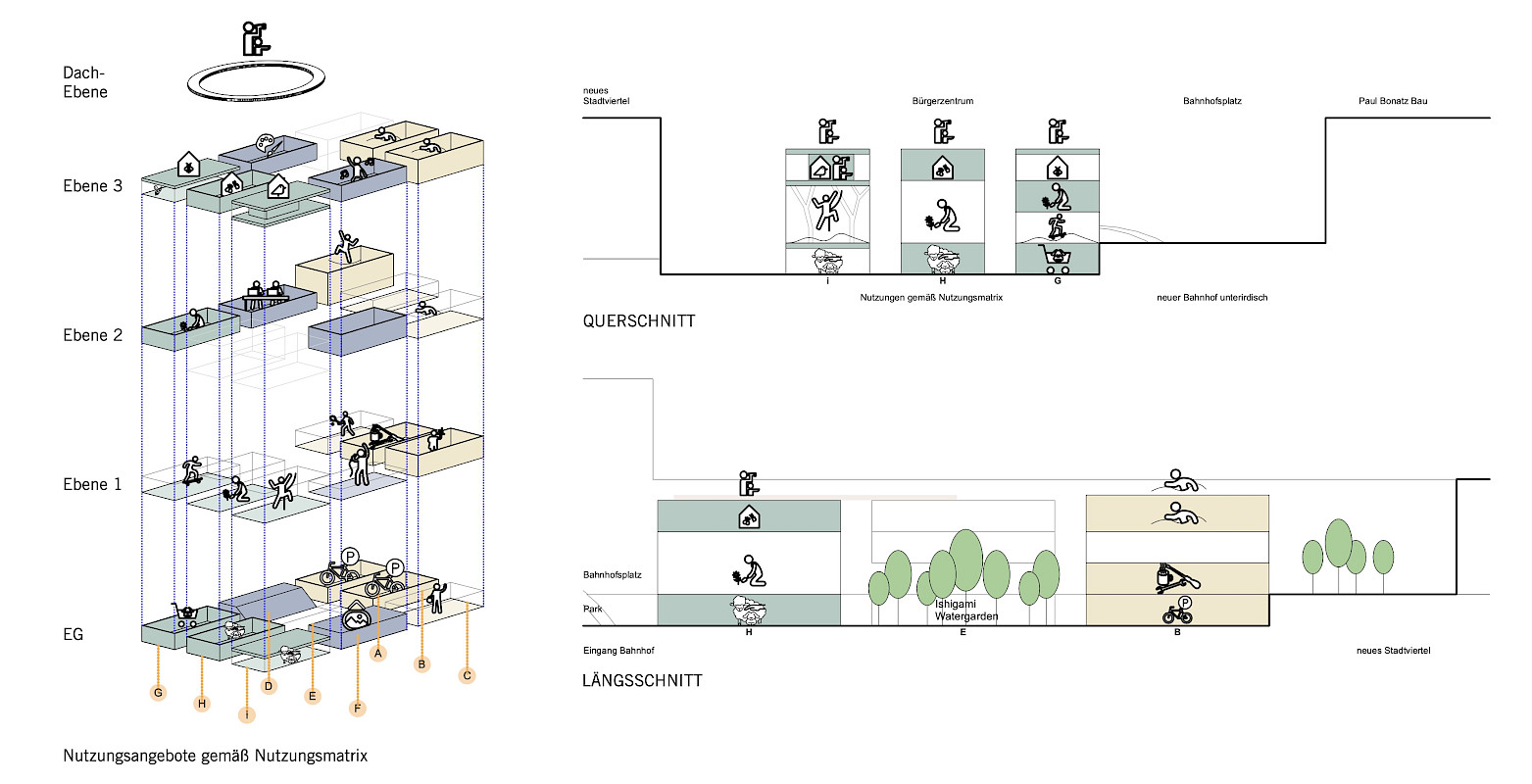
Der Entwurf basiert auf einer modularen Struktur mit neun gleich großen Feldern, die einen zentralen, offenen Atriumhof umschließen. So entsteht ein vielseitig nutzbarer Stadtraum, der sich flexibel mit Sport, Kultur, Natur und Bildung füllt. Die nördlichen Felder bieten Raum für Aktivitäten wie Basketball, Skaten und Schwimmen, die mittleren für Veranstaltungen und Ausstellungen, während die südlichen, zum Park orientierten Bereiche naturbezogene Erlebnisse wie Streichelzoo, Kletterwald oder Urban Gardening ermöglichen.
Architektur Beschreibung
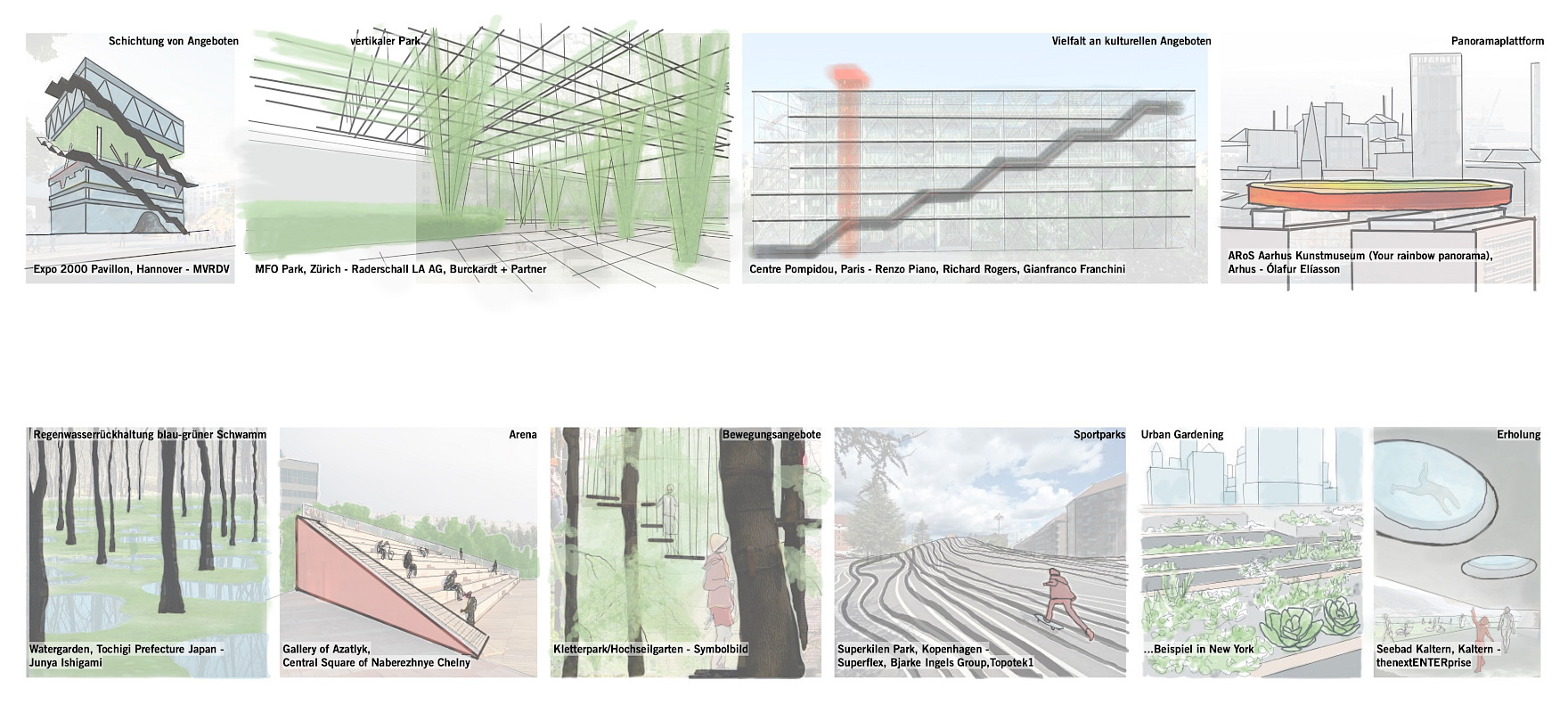
Das Gebäude ist als durchlässiger, offener Baukörper konzipiert – inspiriert von der Idee einer Schwammstadt, die Regenwasser aufnimmt und verdunstet. Das intensiv begrünte Dach und der grüne Innenhof mit Retentionsfläche(nach dem Waterpark von Ishigami) verbessern das Mikroklima und fördern die Biodiversität im Stadtraum.
Zugängliche Vogel- und Insektenhäuser machen ökologische Prozesse sichtbar und regen zum Lernen im öffentlichen Raum an. Die Architektur fördert natürliche Belüftung und Belichtung und setzt bewusst auf klimapositive, nachhaltige Stadtentwicklung.
Konstruktion
Das begrünte Flachdach wird nicht nur zur ökologischen Aktivfläche, sondern auch zum urbanen Erlebnisraum: mit einem Schwimmbad, einer Rooftop-Bar und einem 360° Panoramaweg, der als Aussichtspunkt einen beeindruckenden Blick auf Bahnhof, Stadtpark und Innenstadt bietet. Der Entwurf nutzt dabei einfache, wiederholbare Module, die sowohl gestalterisch als auch konstruktiv für maximale Flexibilität und Nachhaltigkeit sorgen.
Initial Situation
The project site is located directly adjacent to Stuttgart Central Station—an area with significant urban potential and high levels of activity from travelers, residents, and visitors. The brief called for a concept that enables non-commercial, open, and intergenerational use, contributing to the social activation of the new station district.
Concept
The design is based on a modular structure of nine equally sized fields arranged around a central open atrium courtyard. This creates a versatile urban space that can be flexibly activated with sports, culture, nature, and educational programs. The northern fields accommodate activities such as basketball, skating, and swimming; the central fields are designated for events and exhibitions; while the southern areas, oriented towards the park, enable nature-based experiences such as a petting zoo, climbing forest, or urban gardening.
Architecture Description
The building is conceived as a permeable, open structure—drawing on the concept of a sponge city that absorbs and evaporates rainwater. The intensively greened roof and the landscaped inner courtyard with retention areas (inspired by the Waterpark by Ishigami) improve the microclimate and promote biodiversity within the urban environment.
Accessible bird and insect habitats make ecological processes visible and encourage learning in public space. The architecture promotes natural ventilation and daylighting while deliberately focusing on climate-positive and sustainable urban development.
Construction
The green flat roof functions not only as an ecological active surface but also as an urban experience space, featuring a swimming pool, a rooftop bar, and a 360° panoramic walkway offering views over the station, city park, and inner city. The design employs simple, repeatable modules that ensure maximum flexibility and sustainability, both in architectural expression and construction.